BIGCOL
Well-Known Member
Hi everyone,
This is the first report from a two week trip that Jen and I did in late February early March 2015.
We left Melbourne fairly early and headed up the Hume Freeway for Chiltern which was to be our first stop. Located not far from Albury Wodonga, Chiltern was first founded in 1858/59 shortly after gold was found nearby. Many of the buildings that still stand there today are from that era and are classified by the National Trust.
Quite a few notable people were born here as well, Sir John (Black Jack) McEwan Australia’s 18th Prime Minister being one of them.
The first building I photographed was the Federal Standard Newspaper Office built in 1858. It is one of only a few newspaper offices still standing from Australia’s gold rush era and one of the more substantial buildings in town.


Right along the main street there are numerous buildings that give you that feel as though you have been transported back in time. Even an old letter box, and a phone booth from a slightly later period were prominent in the street scape.


There is a lot more to see than just these photos I’m showing you, but they capture some of the character of this historic town.


The wording on these doors was interesting, I hadn’t heard of the phrase of having a “neds" but I think it could mean checking something out or having a browse?

There is so much to see in Chiltern but as with most of my trips, I still had a fair bit to conquer that day so we had to push on. It is a fascinating town and although just off the main Hume Freeway, it is definitely worth stopping at and enjoying, sadly many just drive by not realising what a little gem of a place it is.
From there we headed nearly directly north taking a virgin road towards Howlong. I kept saying I wonder how long it would be till we got to the next town, or how long has that house or bridge been there etc, as we passed various things along the road. Jen gave me that what are you carrying on about, boy this is going to be a very long two weeks type look. Shortly after we were greeted by the HOWLONG town sign, she again glanced at me then put her head in her hands and sighed. I think she then realised yes it would be a long two weeks with just me Ha!
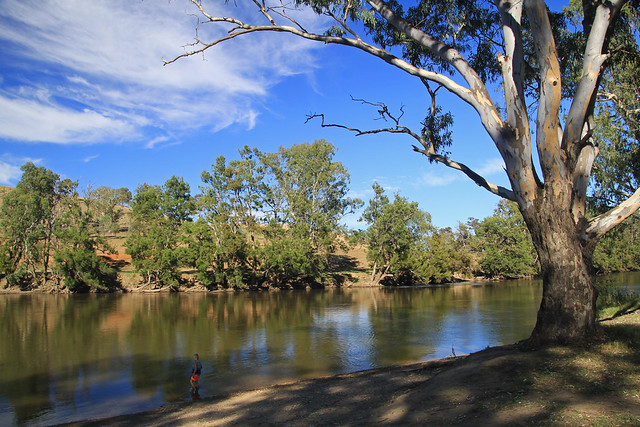
Just over the Murray on an annabranch of the river just before you enter Howlong, there is a lovely park that allows free camping for 48 hours. (Howlong Lions Park). What a lovely spot and there were a few vanners there enjoying it.

https://flic.kr/p/rk4fNB

Our next stop was Lockhart about 100 ks further north, the sign welcoming us gave an indication that this town could be special, and special it was.

As we approached the town centre I spied their Railway station, always a good start to get the feel for a new town. It was beautifully presented freshly painted showing a pride in their past, I was hopeful of more surprises.

At the entrance to the local caravan park there was this sculpture, this was the first of many that we saw, later realising that this town prided itself on this and other forms of art.

We were impressed with this particular one.
 [
But Jen preferred our current mode of transport although be the end of this trip they would be of a similar colour!

Directly across the road from that and on a working service station was this.

The use of the corrugated iron looked brilliant giving it a great 3 dimensional look, that type of iron work would be used time after time throughout the town.
Each year in October the town runs the Spirit of the Land Lockhart Festival and in 2014 more than 6000 people came to enjoy what it had to offer and view the amazing exhibits, hence all the artwork.
However there was more to this town than just that. At the show grounds and race track these very old impressive gates were installed as a memorial to the early pioneers who settled the district. The 22 imitation wool bales have the names of the original 22 homesteads embossed on them, a grand entrance to a avenue that leads towards the race track and show grounds.

https://flic.kr/p/rk4fNB

The first race meeting was held here in 1898 and this very impressive grandstand, which was built in 1906, had only recently been restored to its original grandeur, was the centre piece attraction for a very long time.

It had witnessed a lot over the years but a race meeting in 2009 had a never before seen event happen. This is a description of that event.

And of course it had been recorded for posterity by another piece of art.

Right in the heart of town, on a vacant block or park there was always another piece of stunning artwork to be appreciated.

https://flic.kr/p/rk4fNB

https://flic.kr/p/rk4fNB

This is the first report from a two week trip that Jen and I did in late February early March 2015.
We left Melbourne fairly early and headed up the Hume Freeway for Chiltern which was to be our first stop. Located not far from Albury Wodonga, Chiltern was first founded in 1858/59 shortly after gold was found nearby. Many of the buildings that still stand there today are from that era and are classified by the National Trust.
Quite a few notable people were born here as well, Sir John (Black Jack) McEwan Australia’s 18th Prime Minister being one of them.
The first building I photographed was the Federal Standard Newspaper Office built in 1858. It is one of only a few newspaper offices still standing from Australia’s gold rush era and one of the more substantial buildings in town.
Right along the main street there are numerous buildings that give you that feel as though you have been transported back in time. Even an old letter box, and a phone booth from a slightly later period were prominent in the street scape.
There is a lot more to see than just these photos I’m showing you, but they capture some of the character of this historic town.
The wording on these doors was interesting, I hadn’t heard of the phrase of having a “neds" but I think it could mean checking something out or having a browse?
There is so much to see in Chiltern but as with most of my trips, I still had a fair bit to conquer that day so we had to push on. It is a fascinating town and although just off the main Hume Freeway, it is definitely worth stopping at and enjoying, sadly many just drive by not realising what a little gem of a place it is.
From there we headed nearly directly north taking a virgin road towards Howlong. I kept saying I wonder how long it would be till we got to the next town, or how long has that house or bridge been there etc, as we passed various things along the road. Jen gave me that what are you carrying on about, boy this is going to be a very long two weeks type look. Shortly after we were greeted by the HOWLONG town sign, she again glanced at me then put her head in her hands and sighed. I think she then realised yes it would be a long two weeks with just me Ha!
Just over the Murray on an annabranch of the river just before you enter Howlong, there is a lovely park that allows free camping for 48 hours. (Howlong Lions Park). What a lovely spot and there were a few vanners there enjoying it.
https://flic.kr/p/rk4fNB
Our next stop was Lockhart about 100 ks further north, the sign welcoming us gave an indication that this town could be special, and special it was.
As we approached the town centre I spied their Railway station, always a good start to get the feel for a new town. It was beautifully presented freshly painted showing a pride in their past, I was hopeful of more surprises.
At the entrance to the local caravan park there was this sculpture, this was the first of many that we saw, later realising that this town prided itself on this and other forms of art.
We were impressed with this particular one.
[But Jen preferred our current mode of transport although be the end of this trip they would be of a similar colour!
Directly across the road from that and on a working service station was this.
The use of the corrugated iron looked brilliant giving it a great 3 dimensional look, that type of iron work would be used time after time throughout the town.
Each year in October the town runs the Spirit of the Land Lockhart Festival and in 2014 more than 6000 people came to enjoy what it had to offer and view the amazing exhibits, hence all the artwork.
However there was more to this town than just that. At the show grounds and race track these very old impressive gates were installed as a memorial to the early pioneers who settled the district. The 22 imitation wool bales have the names of the original 22 homesteads embossed on them, a grand entrance to a avenue that leads towards the race track and show grounds.
https://flic.kr/p/rk4fNB
The first race meeting was held here in 1898 and this very impressive grandstand, which was built in 1906, had only recently been restored to its original grandeur, was the centre piece attraction for a very long time.
It had witnessed a lot over the years but a race meeting in 2009 had a never before seen event happen. This is a description of that event.
And of course it had been recorded for posterity by another piece of art.
Right in the heart of town, on a vacant block or park there was always another piece of stunning artwork to be appreciated.
https://flic.kr/p/rk4fNB
https://flic.kr/p/rk4fNB
Last edited:


 [/url