Larger tyres = better fuel economy, for me anyway

Xagtho

Active Member
Hi all, I've been paying a bit more attention to my fuel consumption over the last few months and have found that I get better mileage out of my 33's than on my 31's.

Vehicle in question '02 mitsubishi triton v6 manual.

I usually run a set of 31x10.5 r15 all terrains for around town, they've done a lot of kays and were due for replacement.

I have a fairly new set of 33x12.5 r15 mud terrains that I use for trips and weekends.

I use my ute as my work car and it is always fairly loaded with tools, canopy, ladder racks and full of ladders. It usually tips the scales at 2.6t give or take a hundred kilos.

My car on the worn 31"s around town average 16.2 litres per 100 kays, with the car showing 100kmh gps shows it is only doing 96kmh, so doing the math I'm actually using 16.8 litres per 100.

After my last 4x4 weekend away I got a bit lazy and left my 33" muddies on for a few weeks and noticed that I was returning the same 16.2 litres per 100, when the car is showing 100kmh the gps shows I'm doing 103kmh, so with the adjustments made it is really acheiving 15.7 litres per 100.

So I thought I'd test the theory and bought a new set of around town A/Ts at 285/75R16, they're a little larger than my 33x12.5 muds. At a speedo indicated 100kmh the gps shows 105kmh, over the last 8 tanks I have found the fuel consumption to be 16.1 litres per 100, with the adjustments applied it comes up with 15.3 litres per 100.

In summary:
31x12.5R15 = 16.8 L/100
33x12.5R15 = 15.7 L/100
285/75R16 = 15.3 L/100

I have noticed that I am driving from the gps speedo a lot more so I don't lose my license, and in turn, even though my cruising speeds remain the same my rpm is noticeably lower, ~200 to 250rpm lower at 100kmh.

It may not be a huuuge amount of difference, but 1.5 litres per hundred better off, or being able travel 38km further between refills, or nearly 10% better economy, it's a noticable difference. And with me driving 60,000 kays a year in it, I'll be over $1000 better off after 12 months.

I'm not really sure what this "rolling resistance" stuff is but it obviously doesn't have a big effect on my vehicle, & it shows that my car could do with a bit taller gearing.

My advice for anyone else driving a car like mine, go bigger
 

Gavo

4x4 Earth Contributer
Interesting analysis! Haha sounds like @ set of 35s are on the cards! Interesting Storey all the same. Funny how different vehicles return different fuel economy!
 

prawns

Moderator
I always thought it worked like

City Driving:
Bigger wheels=more engine load to get moving all the time at lights=more fuel used

Country Driving:
Bigger wheels=lower rpm at highway speed=less fuel used

No idea - interesting subject tho
 

03hilux

4x4 Earth Contributer
I always thought it worked like

City Driving:
Bigger wheels=more engine load to get moving all the time at lights=more fuel used

Country Driving:
Bigger wheels=lower rpm at highway speed=less fuel used

No idea - interesting subject tho

Theoretically, taller and wider tyres offer more resistance, so needing more torque hence more fuel beiing used, regardless of city or country driving.

It also works the same for new v worn tyres. As a tyre wears, most tyres will have more rubber on the rd, because the tread sipes (grooves) are basically a v shape, which will marginally increase fuel useage. As said, marginally increase.
 

Xagtho

Active Member
That's it Gav, & let us know your findings.


Yeah Prawns, from what I had read I thought it was going to be the other way around myself as most of my kays are city.


03 hilux, if that's how the rolling resistance stuff works then say if you were on a set of say 31x10.5 highway terrain which have a surface area of about 90% rubber and 10% void you would have a road contacting surface area of 0.59m2.
Then if you were on a set of aggressive mud terrains at 31x10.5 with a surface area of 50% rubber and 50% void, you would have a road contacting surface area of 0.33m2.
Even if you went up in size to a set of aggressive mud terrains at 35x12.5 with a surface area of 50% rubber and 50% void, you would have a road contacting surface area of 0.42m2.

31x10.5 HT 90% road contact area = 0.59m2
31x10.5 MT 50% road contact area = 0.33m2
35x12.5 MT 50% road contact area = 0.42m2

Is this how it works? would that mean that we could all save fuel by running mud terrains? even larger ones?

If it is then it's a very good tool to use against the minister of war and finance;)
 

krazed

Active Member
my 32's mt's use about 3 ltrs per 100 more than my ht's (29.5) around town . On the highway the mt's are only about .5 ltr more per 100 . I thought diff ratios had a bit to do with it as well ???. e.g they are set to the standard size diameter tyre that the car was sold with . Putting tyres on 3+ inches larger requires changing of diff ratios to better the fuel economy . Im no pro but that was my understanding anyways :S . As my muddies are on spare rims and only on when i go wheeling i wouldn't bother but if i was to run them fulltime id look in to it i reckon
 

Xagtho

Active Member
Hey krazed, had you put in the tyre size increase into your calculations?

As the difference between a true 29.5 and a true 32 is about 8%, depends on how many L/100 but you may find that you are better off also.

Changing the diff ratio is a way to get the standard overall gearing back when you fit different size tyres.
 

Outrage

4x4 Earth Contributer
The taller/wider theory is correct under a general approach, if that is all you look at it should be right, however with an engine and gearbox in the picture, we now have engine speeds and it's efficiency at different loads and speeds to deal with. A manufacturer will aim for a size that has the engine operating at a good efficiency while not being too small or large for other reasons.

Appears for xagtho, the loss of economy by going with larger tyres, is offset by a gain in economy with engine load/speed operation.

Re mud/vs highway, although the bigger lugs would mean less contact with the ground and thus less resistance as such, every time those lugs hit the ground it won't be as smooth a transition as a highway tyre, each little impact takes more effort to turn than a smoother highway tyre. Off-road tyres are typically heavier than a road tyre too, so you're turning more mass/takes more effort even if it's the same size. Similar theory as pumping your tyres right up will use less fuel because a) less tyre is on the ground and b) the trye is more circular and thus easier to turn, however you will now have a harsher ride and less traction in an emergency.

Many factors influence things, the question is which will have the biggest effect.

It could even be that xagtho's old 31's are out of shape/bit uneven, etc and that's causing the higher figures and a new set of 31's would be even less than the 33's. How much spare money do we have to test this though :)
 

krazed

Active Member
Dunno mate . Like i said i am no pro ;) All i know is i take the same route to work everyday and those are the figures . Also i notice that places where i normally coast on ht's(no acceleration) i have to accelerate on mt's to keep speed . Just seems to me when i have the muddies on i always have the foot on the go pedal (even if just the slightest) as apposed to the ht's where i get to coast a fair bit .:cool:
 

Xagtho

Active Member
It could even be that xagtho's old 31's are out of shape/bit uneven, etc and that's causing the higher figures and a new set of 31's would be even less than the 33's. How much spare money do we have to test this though :)

Hi Outrage, the old 31's were correctly balanced evenly worn yokohamas.

& 285/65R16 is 33x12.5R16 in the old speak, it's just that not all 33's are created equal.
 

Xagtho

Active Member
Dunno mate . Like i said i am no pro ;) All i know is i take the same route to work everyday and those are the figures . Also i notice that places where i normally coast on ht's(no acceleration) i have to accelerate on mt's to keep speed . Just seems to me when i have the muddies on i always have the foot on the go pedal (even if just the slightest) as apposed to the ht's where i get to coast a fair bit .:cool:

Aha, I see

What car & diff ratio do you have?
 

bluehilux

Banned
Xagtho
What brand are the 33's ? and do some new tyre compounds have less rolling resistance ?
Just a thought i had.
I only went from 30 to 31 but fuel consumption was not noticeable, only the slight power loss due to the engine using more torque to get going due to the 31 making it slightly higher geared.
 

Xagtho

Active Member
Hi bluehilux, they are nankang mudstars and goodyear wranglers.

Tyres with that silica compound in them are meant to give you better economy but neither of mine have it.
 
Last edited:

phs

Well-Known Member
I was under the impression 285/75 16s are slightly smaller od than 33x12.5 15s well they look that way stacked in my garage . Either way they are close but the width is definetly skinnier meaning less power to maintain speed even Thow the larger diameter uses more energy to get moving once moving keeps momentum better so theoretically 35x10.5 16 should be a very economical tyre for FWY driving Thow around town may use a little more than your stick tyre

I run 285x75 16 on my cruiser and averaged 12.3 lts per 100kms over 150lts I was counting Thow my speedo reads spot on The speed limit with these tyres id imagin with std tyres it would be 5% less so 11.somthing per 100kms

I think Toyota state 11 per 100 but people rarly meet there wishfull thinking statistics
 
Last edited:

Xagtho

Active Member
Hi phs, yes numbers on tyres are one thing, actual measurements are another, not all tyres are created equal.

I have a set of 33x12.5R15's bfg all terrains on the wifes car, which are about an inch taller and wider than the 33x12.5R15 nankang mudstars that I use on the ute.

The 285/75R16s I have are also about an inch taller than the nankangs, but I'm not sure if they are as wide as the BFGs.
I'll have to take a wheel off & take some piccies.

From what I've seen mud terrains are usually skinnier than all terrains, even of the same brand, & there's a good reason for that.

I also imagined that I'd get better mileage out of standard sized tyres, but the tests show a different story.

With your 79 I reckon you might also acheive better mileage with larger than standard tyres, but you'd have to test it with the standard size first to know for sure.

Yes, factory consumption figures are a little optomistic, a co worker of mine drives a VDJ78 and he returns 15-16 L/100 around town.

On the highway taking it easy on the speed limit I have returned figures as low as 12L/100.
 

phs

Well-Known Member
I guess every brand is different my 285 75 pro comp ats are slightly smaller than 33x12.5 mtzs it is marginal Thow .

My driving is half fwy half city

Short trip is a killer if you only drive 10-15 mins each way it would increase a fair bit

the gearing in the VDJ s does suit bigger tyres unless towing . 3inch exhaust egr blank and having the tray empty helps alot in keeping the lts per 100 down and of course injector health on any common rail is a huge factor in fuel use age .

People always say bigger tyres worse mileage I think it depends on the vehicle , what type of driving city or fwy, and tyre width, as a wider tyre will take more energy to keep rolling
 
Last edited:

Xagtho

Active Member
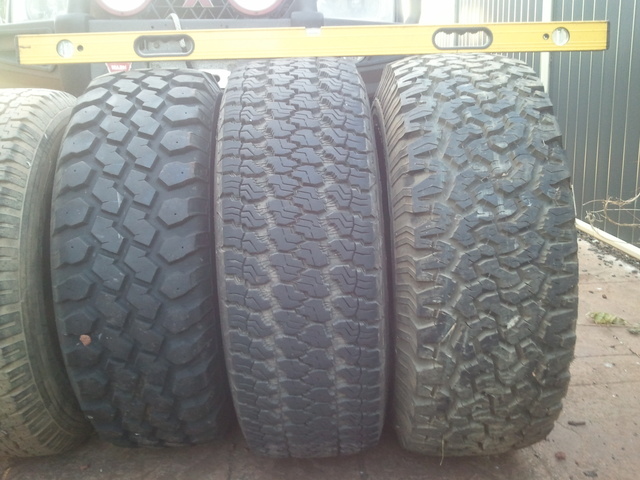
Here's a pic of mine for comparison:
On the left a 33x12.5R15 nankang mudstar MT which has done a lot of the vic high country, little desert, big desert, simpson desert, birdsville track, uluru, flinders ranges, limestone coast etc, maybe 15-20k km.

Middle is 285/75R16 goodyear wrangler silent armour AT which has done 3-4 thousand road km.

Right is a dusty but brand new 33x12.5R15 BF Goodrich AT.

20130528164605.jpg


Don't worry about my camera skills, the spirit level was reading level, the cameraman on the other hand was not.
The goodyear and bfg are almost identical in height, while the nankang is noticebly shorter and thinner.
Tread width from left to right 9" 9.5" and 10".
 
Top