
You are using an out of date browser. It may not display this or other websites correctly.
You should upgrade or use an alternative browser.
You should upgrade or use an alternative browser.
Battery check up
- Thread starter RussF
- Start date

03hilux
4x4 Earth Contributer
Give the a whirl. It may help
http://www.rapidtables.com/calc/electric/Volt_to_Amp_Calculator.htm
http://www.rapidtables.com/calc/electric/Volt_to_Amp_Calculator.htm

Albynsw
Well-Known Member
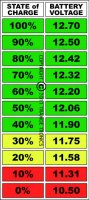
Russ the chart that Tink provided shows you the percentage of battery power used/ left
From there you will need to apply that percentage to the storage capacity of your battery
Keep in mind that the rating of your battery , say 80a/h battery for example is not the useable capacity available, it varies with battery type and brand but as a general rule of thumb most work on 50% usable capacity out of the batteries stated capacity.
So not the straight forward easy answer you were looking for but if you google the subject there is a lot of information available to better understand it all. The Redarc site has some good information on 12volt systems and calculating battery capacities to suit your needs but there are lots out there.

sharkcaver
Well-Known Member
how can you check how many AMP hours left in your battery, I understand you can check with a multimeter but how do you change that voltage number to hours
Cheers Russ
In a nutshell, as a layman you cant with any degree of accuracy. From the day you bought your nice shiny new battery home, it will have been losing capacity. You could do a percentage thing using state of charge, but not only is state of charge an iffy value, but combined with an iffy amp hour capacity, you end up with a double iffy answer.
Best scenario is to monitor the iffy state of charge to determine when a recharge is needed. 50% is recommended recharge time, deep cycles can recover down to 20% but thiis will efect lifespan over time.
BTW, SOC is measured as a standing, rested voltage with no load applied. Adding a load will induce voltage drop and make you think its worse than it is.
The question that needs to be asked is why the pre-concern with amp hours? Unless you are monitoring loads in amp hours, it becomes irrelevant. SOC is the easiest value to monitor.
Thanks for the explanation Albynsw as a non techo I was asuming that if your battery drew a certain amount and your Led lights drew an amount and your battery was 80 AMP hour, you would have an idea of how many days (hours) you could stay in the bush, but not so true thanks for the explanation boysRuss the chart that Tink provided shows you the percentage of battery power used/ left
From there you will need to apply that percentage to the storage capacity of your battery
Keep in mind that the rating of your battery , say 80a/h battery for example is not the useable capacity available, it varies with battery type and brand but as a general rule of thumb most work on 50% usable capacity out of the batteries stated capacity.
So not the straight forward easy answer you were looking for but if you google the subject there is a lot of information available to better understand it all. The Redarc site has some good information on 12volt systems and calculating battery capacities to suit your needs but there are lots out there.
Thanks shark caver as a non techo I was trying to work out how many hours my battery will run my fridge and lights, if you don't mind how does SOC work in simple termsIn a nutshell, as a layman you cant with any degree of accuracy. From the day you bought your nice shiny new battery home, it will have been losing capacity. You could do a percentage thing using state of charge, but not only is state of charge an iffy value, but combined with an iffy amp hour capacity, you end up with a double iffy answer.
Best scenario is to monitor the iffy state of charge to determine when a recharge is needed. 50% is recommended recharge time, deep cycles can recover down to 20% but thiis will efect lifespan over time.
BTW, SOC is measured as a standing, rested voltage with no load applied. Adding a load will induce voltage drop and make you think its worse than it is.
The question that needs to be asked is why the pre-concern with amp hours? Unless you are monitoring loads in amp hours, it becomes irrelevant. SOC is the easiest value to monitor.
Cheers Russ
BTW, SOC is measured as a standing, rested voltage with no load applied. Adding a load will induce voltage drop and make you think its worse than it is.
Totally disagree. If testing the voltage of a battery, it needs to be done whilst the battery is under load. Testing a resting battery may result in a false reading due to a surface charge from a recent charging event. Testing a resting battery will not show that a cell is faulty in the battery. Adding a load will eliminate both these false test results.
Obviously, if adding a load, you test the voltage across the battery terminals and not at the end of a cable run. If testing at an outlet or at the fridge, yes volatge drop would effect the test results.
Tink
sharkcaver
Well-Known Member
Sorry Tink you are mixing two types of tests.Totally disagree. If testing the voltage of a battery, it needs to be done whilst the battery is under load. Testing a resting battery may result in a false reading due to a surface charge from a recent charging event. Testing a resting battery will not show that a cell is faulty in the battery. Adding a load will eliminate both these false test results.
Obviously, if adding a load, you test the voltage across the battery terminals and not at the end of a cable run. If testing at an outlet or at the fridge, yes volatge drop would effect the test results.
Tink
Load testing a battery is obviously done under load. This will show what CCA the battery can produce v's an expected voltage. That is not measuring state of charge but current producing or load generating capacity.
State of charge is a measure of a battery in a rested position and only concerns voltage. You will note I also used the term rested. What that means is that it has to be rested or have a small load applied to remove any surface charge if it has been recently charged. That load is also removed when determining what the state of charge is. It has to be, otherwise the voltage measurement and hence SOC will be lower than actual.
As you say, you measure this at the battery not any cable termination (why would think so I don't understand). A load will induce the battery to drop voltage, hence why soc is measured unloaded and as mentioned.....rested. Good quality battery monitors that measure state of charge in a live situation use an alogarithm to determine % based on load and voltage drop. If it can be done on a battery monitor, it could be done in the field, but I've never seen a link to any alogarithm like that.
Load testing and SOC are two separate processes. One process alone will not tell you the full story. The reason why I say the layman cant do this with any measure of accuracy is because most people don't have a load tester lying around. They are a large expensive bit of kit. Measuring voltage on the other hand, most people can do.
sharkcaver
Well-Known Member
SOC gives a determination of battery voltage and by default its charge capacity. This voltage is directly related to the chemical process within the electrolyte its self. Old school (and arguably a more accurate measure) was to measure the specific gravity of the electrolyte. Which in the field is a pita. Not only that, most batteries these days are sealed MF types - you cant get to the electrolyte no moreThanks shark caver as a non techo I was trying to work out how many hours my battery will run my fridge and lights, if you don't mind how does SOC work in simple terms
Cheers Russ
 . Tink touched on some issues that theoretical soc wont show, IE an under performing cell. It should however show a dropped cell.
To work out how much time your battery will last, you need to know your usage. Lights etc are pretty easy to determine, they are a fixed load. A fridge is a different matter. That is a constantly changing load. You need to determine a baseline for the fridges consumption to have any idea of how long you will get from the battery.
As that load can vary considerably, in the field its just easier to monitor voltage, which is cheap and easy to do. When your battery drops to 12.0V (unloaded), you are at the theroretical 50% level and need to think about getting some charge back into it. What fridge are you running?

stevemc181
Well-Known Member
For a much more accurate state of charge, you need to use something like a Victron BMV 702 monitor. I use one of these with my LifePo4 aux battery, and at a glance I can tell the batteries SOC and how long I have to run at the current consumption rate. Bit of overkill, but it gives me a wealth of info on how my battery is performing. My LifeP04 is a bit different to a Lead acid though, as it will run at or near 13volts until 90% discharged. The BMV-702 gives me a pretty accurate measurement of how things are going.
Engle MT45FPSOC gives a determination of battery voltage and by default its charge capacity. This voltage is directly related to the chemical process within the electrolyte its self. Old school (and arguably a more accurate measure) was to measure the specific gravity of the electrolyte. Which in the field is a pita. Not only that, most batteries these days are sealed MF types - you cant get to the electrolyte no more
To work out how much time your battery will last, you need to know your usage. Lights etc are pretty easy to determine, they are a fixed load. A fridge is a different matter. That is a constantly changing load. You need to determine a baseline for the fridges consumption to have any idea of how long you will get from the battery.
As that load can vary considerably, in the field its just easier to monitor voltage, which is cheap and easy to do. When your battery drops to 12.0V (unloaded), you are at the theroretical 50% level and need to think about getting some charge back into it. What fridge are you running?
sharkcaver
Well-Known Member
That should chew about 20Ah/day. Again lots of factors will vary that value, but that's a pretty good safe all round number. Going on that, you should get aprox 2 full days on an 80Ah battery if you neglect the lights you mention. They should only be on for a few hours and if LED strip, will consume bugger all. Note the 2 days will be down to 50% soc, approximately 12.0V standing.
See here for some consumption figures:
http://sharkcaver.blogspot.com.au/2012/05/generation-of-engels.html
See here for some consumption figures:
http://sharkcaver.blogspot.com.au/2012/05/generation-of-engels.html